


News & Events

Hong Kong, 4 September 2026 -- China Chengxin (Asia Pacific) Credit Ratings Company Limited (“CCXAP”), CGS International Holdings and DMI jointly hosted an online seminar themed “Reassessing the Value of Multilateral Institutions: Regional Cooperation and Emerging Market Financing amid Great-Power Rivalry,” which attracted a large number of domestic and international investors to participate online.
The seminar helped investors understand how multilateral institutions promote regional cooperation, mobilize capital, and how their credit analysis framework and future direction will evolve. This event analyzed, from a macro research perspective to a micro perspective, the evolving role of multilateral institutions and changes in their credit, helping deepen investors’ understanding of the credit of multilateral institutions.
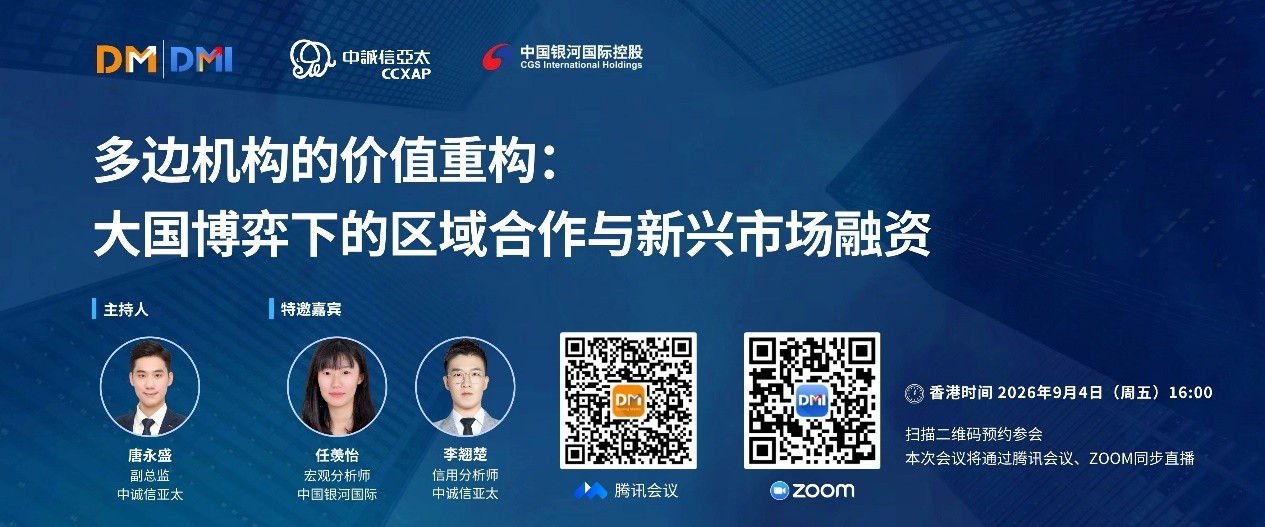
The seminar was moderated by Mr. Tong Wing Shing, Associate Director of CCXAP, and invited Ms. Ren Xianyi, Macroeconomic Analyst at China Galaxy International, and Mr. Li Qiaochu, Analyst at CCXAP, to deliver presentations.
Ms. Ren Xianyi, Macroeconomic Analyst at China Galaxy International, said that since 2018 geopolitics has had a markedly greater impact on trade and investment flows. Cross-border capital is being reallocated along geopolitical lines, and regional cooperation has shifted from a development agenda to a resilience agenda. Shared gains, she noted, do not automatically translate into collective action: cross-border projects remain constrained by misaligned returns, incentives and rules. At the same time, the emerging-market financing gap is still measured in the trillions of US dollars. Public fiscal space has narrowed, while most private capital remains in high-income countries and will not fill the gap on its own. In her view, the value of multilateral institutions does not lie in simply providing funds, but in closing these two gaps: using policy, rules, projects and information coordination to support regional collective action; and using guarantees, risk-sharing and co-financing to improve project bankability and crowd in private capital. From 2012 to 2024, bilateral and multilateral institutions mobilized more than USD 600 billion of private capital in aggregate, with guarantees showing higher leverage.
Mr. Li Qiaochu, Analyst at CCXAP, discussed the underlying credit profile of multilateral institutions and their likely direction through a rating framework. He noted that multilateral development banks are jointly capitalized and jointly governed by multiple countries and are not profit-maximizing institutions. Preferred creditor status, callable capital and multinational governance mean that their credit standing is often stronger than the sovereign ratings of individual member countries. Credit analysis, he said, should consider both standalone credit quality and shareholder support. Standalone analysis should focus on the operating environment, governance, capital strength, asset quality and liquidity. Shareholder support should be assessed in terms of members’ willingness and capacity to provide support.
During the Q&A session, investors actively raised questions on the outlook for regional cooperation, emerging market financing, shareholder support and the credit outlook. The speakers answered each question in turn, and the discussion was thorough. This seminar further demonstrated CCXAP’s important role in connecting international issuers with investors, enabling the market to gain a deeper understanding of changes in the credit of multilateral institutions and of the related analysis framework.